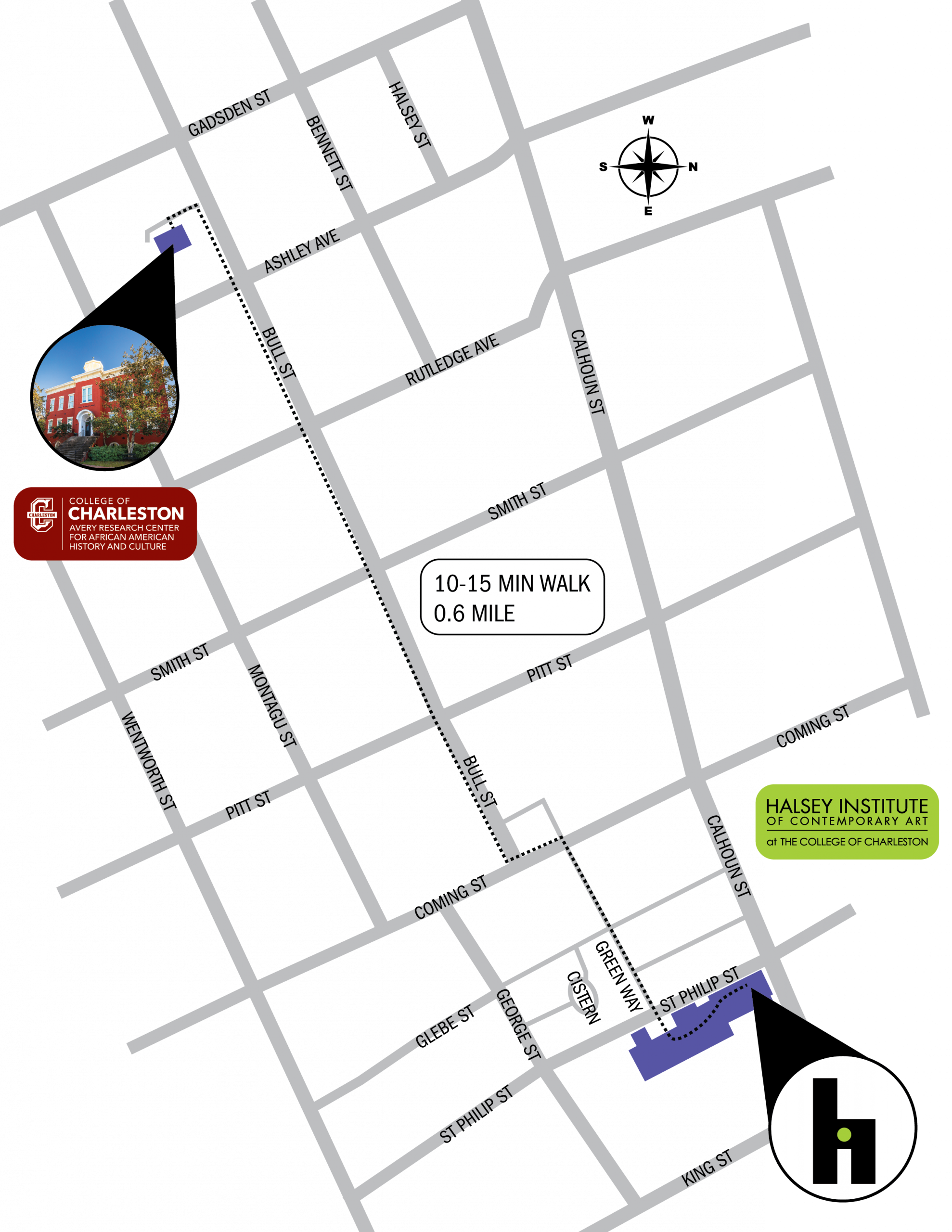
The exhibition continues at the Avery Research Center, located at 125 Bull Street. Works by Maya Freelon and christa david are on view. Plan your visit: avery.charleston.edu.
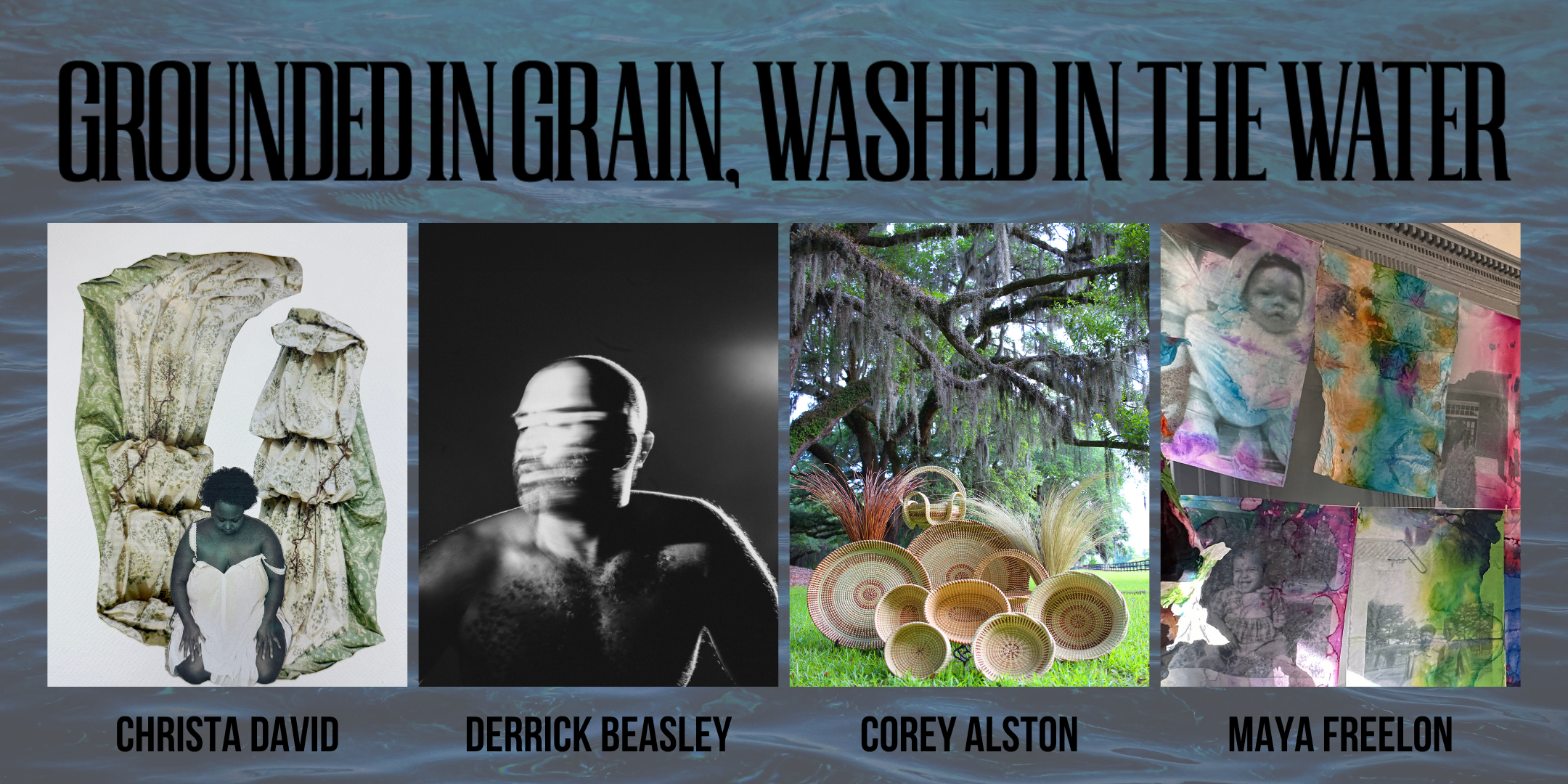
Grounded in Grain, Washed in the Water explores ancestral narratives and the enduring relationships between land, water, memory, and Black life in the American South. Bringing together the work of Maya Freelon, Corey Alston, christa david, and Derrick Beasley, this collaborative exhibition between the Halsey Institute of Contemporary Art and the Avery Research Center for African American History and Culture considers how ancestral knowledge is carried across generations. Rooted in resilience, creativity, and connection, this exhibition explores how the past traverses the body, the land, material traditions, and acts of imagination. The artists reveal that the histories embedded in Southern soil and waterways are not static remnants of the past, but living systems of knowledge that continue to shape contemporary Black life while offering pathways toward collective futures.
The partnership between the Halsey Institute and the Avery Research Center underscores the exhibition’s central premise: history is not confined to the archive. While the Avery preserves the records of African American life, the artists in Grounded in Grain, Washed in the Water activate these histories that often exist beyond written texts and boxed objects. Through inherited gestures like basketweaving, ecological connections to land, spiritual traditions with water, and various creative practices, this exhibition asks us to consider what survives when knowledge is transmitted through making and remembering.
Throughout the South, land and water have long been sites of contradiction. They have endured through forced labor and displacement while simultaneously sustaining communities through farming, fishing, craftsmanship, worship, and kinship. Agricultural knowledge and our relationships to rivers, marshes, coastlines, and fields are rooted in practices carried across the Atlantic by enslaved Africans. Those hands and traditional practices transformed the landscapes of the South. Grain became a commodity through forced labor, and yet a testament to the refined knowledge Africans brought with them. And water remained a powerful symbol in African diasporic traditions, serving as a tool of mourning, spiritual transformation, healing, migration, and renewal. Rather than treating these histories as distant or complete, the artists exemplify how they continue to circulate through contemporary life.
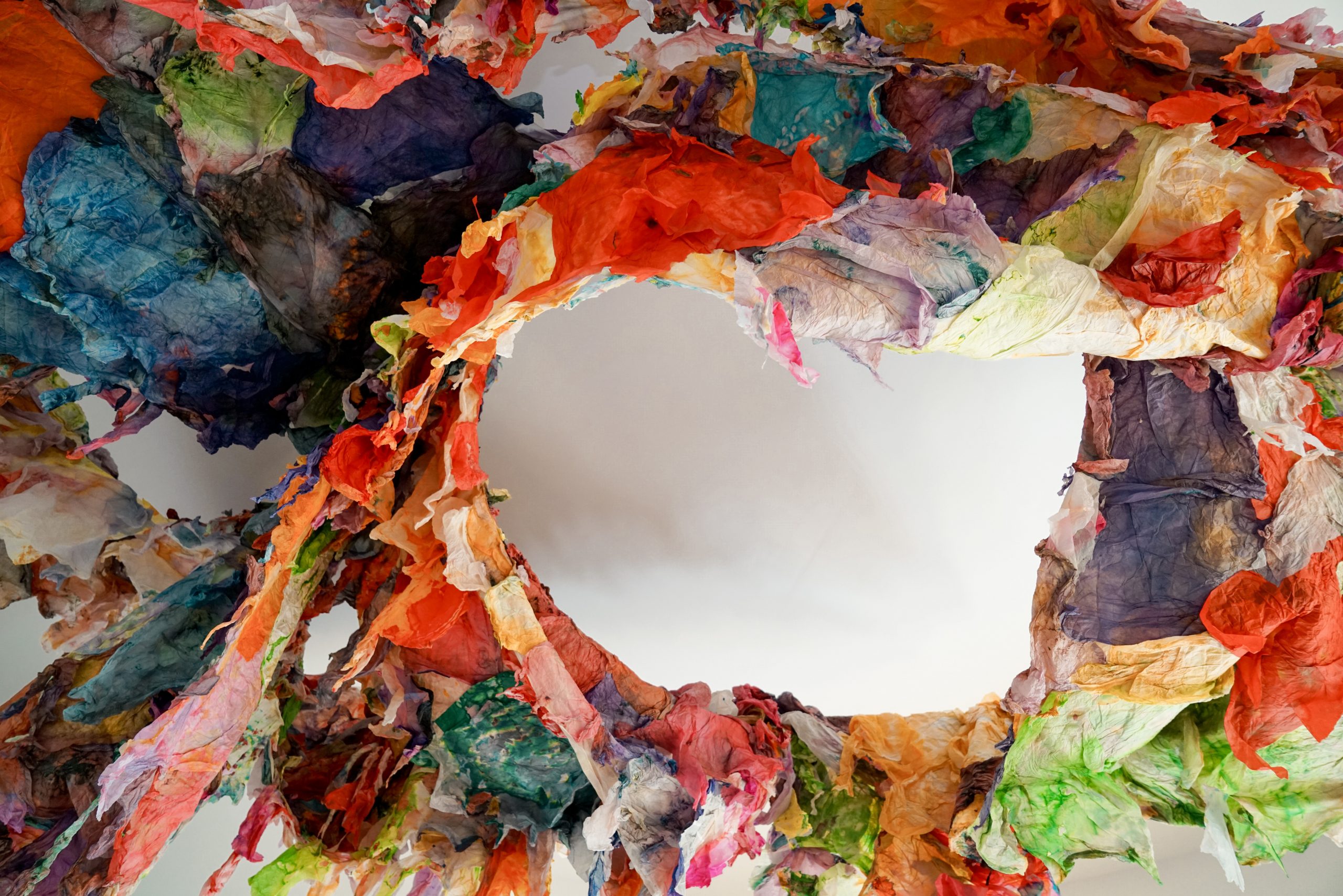
Water moves through this exhibition as both material and metaphor. It holds memory. It carries stories, erodes boundaries, and leaves traces of what has passed. In Maya Freelon’s work, the bleeding watermarks serve as a poignant point of departure for both the fragility and resilience of people of the African diaspora. Drawn to the subtle imprint that signifies “water was once here,” Freelon transforms tissue paper into woven quilt-like forms that act as spiritual archives of collective memory. The delicacy of tissue paper upholds a remarkable strength when layered and woven, an analogy for Black communities whose collective endurance has persisted despite generations of displacement and rupture.
Freelon’s incorporation of archival family photographs further expands this meditation on memory. Printed onto translucent tissue, these images move beyond documentation to become a setting of remembrance. In Freelon’s work, memory is not singular, but communal, layered, and continually reassembled. Her work is an invitation to embrace our ancestral connection to each other and suggests that images preserve history and connect us across generations.
Questions of generational inheritance continue in the work of Corey Alston, whose sweetgrass basketry embodies centries of Gullah Geechee cultural knowledge. A fifth-generation basket maker, Alston carries forward a tradition rooted in West and Central African weaving practives that evolved within the Lowcountry’s rice plantations before becoming one of the region’s most enduring artistic legacies. His practice reminds us that cultural preservation depends not solely on institutions but also on families, communities, and the intentional transmission of knowledge.
Alston learned basket weaving through his wife’s family, and with the blessing of renowned artist and matriarch Mary Jane Manigault, Alston’s journey reflects the relational nature of inheritance itself. Once used solely as essential tools, these sculptural forms continue to honor traditional methods while expanding the possibilities of sweetgrass basketry into contemporary art. As Alston creates and teaches direct descendants, he is stewarding the tradition and reinforcing the idea that heritage is continually renewed through practice, care, and kinship.
Where Freelon and Alston explore memory through fiber and weaving, christa david turns inward, examining the body as a site where ancestral knowledge is quietly received. Across paintings, collage, and fiber sculpture, a recurring kneeling figure occupies a posture of stillness beneath skies filled with shells, peaches, pecans, cacao, moonlight, water, and seed. These suspended forms appear as gifts, memories, prayers, or possibilities descending toward a figure prepared not to grasp, falling and settling on shoulders and open hands.
david’s figurative collage conveys a sense of stillness as a devotional practice, like prayer or meditation. Her work suggests that inheritance requires action. The haint blue draws upon Southern vernacular traditions of spiritual protection, while red clay and pecans anchor the work firmly within the landscapes of her South Carolina upbringing. These familiar materials become tactile reminders that the ground beneath our feet carries histories long before we learn to name them.
Rather than romanticizing the past, david’s work understands memory as something continually unfolding. Harvest appears not merely as agrarian abundance but as spiritual sustenance. A vital reminder that nourishment extends beyond the body to include belonging, reflection, and connection to place. Her work proposes that ancestral wisdom often arrives quietly, through repeated encounters with land, food, rituals, and materials that are evergreen in Black Southern life.
While the exhibition remains deeply rooted in history, it also insists that ancestral knowledge must be understood as preparation for the future. Derrick Beasley extends this conversation through speculative world-building, imagining a future he calls the Reciprocene. Set in the year 2125, his work asks what forms of. knowledge might enable humanity to survive an era defined by climate catastrophe. His answer is neither technological acceleration nor extraction, but reciprocity.
Drawing upon the histories of Black maroon communities who sought refuge in wetlands during enslavement, Beasley imagines ecological relationships founded on mutual care between humans and the more-than-human world. Wetlands become places of refuge and innovation, where survival depends on learning from the intelligence of ecosystems themselves. His installations envision future artifacts, rituals, and technologies grounded in cooperation rather than domination, asking what new ways of living might emerge from the wisdom Black communities have cultivated for centuries.
Beasley’s speculative practice reframes climate change not solely as an environmental crisis but as a call to recover ways of knowing too often dismissed or forgotten. His work reminds us that Black relationships to land have always involved adaptation, fugitivity, stewardship, and collective imagination. In this sense, the future becomes inseparable from memory; the knowledge required to navigate ecological uncertainty may already be embedded in the cultural practices preserved generationally across time.
Together, these artists reveal that Black Southern traditions are not of the past to be preserved, but dynamic systems of knowledge that can be accessed and continue to evolve. Through basketry, collage, sculpture, painting, and immersive installation, these artists demonstrate that ancestral recall must be honored, practiced, embodied, cultivated, and imagined. Grain becomes more than sustenance, and water becomes more than geography. Together, in this exhibition, the work becomes an archive that carries histories beyond individual experience into cultural preservation.
At a moment when climate change, land displacement, cultural erasure, and the continued loss of coastal and Gullah Geechee landscapes threaten both ecological and cultural futures, Grounded in Grain, Washed in the Water, offers a different vision. It asks us to recognize Black Southern knowledge not as something belonging only to the past, but as a living resource for imagining a more just future. The exhibition invites viewers to reflect on what it means to be grounded in community, in memory, and in place, while remaining open to transformative possibilities through living cultural traditions and practices. You are witnessing the beauty and complexity of a heritage shaped by endurance, transformation, and a profound reverence for the earth and water that sustain us all.
Lauren Jackson Harris is a senior-level arts professional, curator, and cultural strategist based in Atlanta, Georgia. With over 15 years of experience across arts administration, curatorial practice, and creative leadership, she has dedicated her career to supporting artists, building community-centered programs, and expanding access to contemporary art spaces.
With a Master of Arts in Creative Business Leadership from the Savannah College of Art and Design (SCAD) and a Bachelor of Fine Arts in Graphic Design and Art History from Howard University, Lauren’s practice merges strategic leadership with creative innovation. Her career spans institutions, nonprofits, museums, academic settings, and public art initiatives, creating a cohesive body of work that reflects both breadth and intentionality.
As a curator, Lauren has organized exhibitions for Atlanta Contemporary, Atlanta Art Fair, Swan Coach House Gallery, and Zucot Gallery, among many others. She has served on advisory boards and selection panels for Dashboard Atlanta, ArtFields, and the Joan Mitchell Foundation, and is a contributor to publications like ArtsATL and Sugarcane Magazine.
In 2019, she co-founded Black Women in Visual Art (BWVA), an organization that connects, cultivates, and supports Black women in the arts. With BWVA, Lauren builds partnerships and develops programs that increase visibility and opportunities for Black women in the arts. Her role as a consultant and cultural producer has included major collaborations such as the Radical Unity Public Art Project, the Atlanta BeltLine, and artist Harmonia Rosales’s studio. Lauren was also the co-founder of The Convening: Women in Art Summit, a 2021 conference designed to foster intergenerational dialogue, support networks, and visibility for women-identifying art workers.
As a sought-after speaker, moderator, and facilitator, Lauren has led or participated in discussions with notable organizations, including The Metropolitan Museum of Art, Art Papers, Living Walls Atlanta, ArtTable, and Georgians for the Arts. Her programs and talks explore the intersections of race, gender, art, advocacy, and institutional change. She recently served as co-chair of the BeltLine Public Art Advisory Council and is currently Executive Director of Dashboard.
As an active art advocate, Harris curates impactful exhibitions, produces innovative art-related projects and programs, while amplifying Black women’s contributions to the art world.
Maya Freelon is an award-winning visual artist and educator who has exhibited her work internationally, including shows in Paris, Jamaica, Madagascar, and Italy. Cosmopolitan Magazine called her “one of the most badass female artists in the biz.” Huffington Post hailed Maya as one of “30 Contemporary Art Makers Under 40 You Should Know,” and Complex Magazine celebrated her “Making Waves in the Art World.” Her artwork was featured on the cover of Walter Magazine and in the books Art of the State and Garden & Gun’s Southern Women.
Freelon’s artwork has been commissioned and collected by the National Gallery of Art, the North Carolina Museum of Art, the National Museum of African American History and Culture, and the Phyllis and Ross Escalette Permanent Collection of Art. Her work has also been commissioned and collected by major corporations and universities, including Google, Cadillac, Duke Hospital, Johns Hopkins University, and First Citizens Bank. Miami New Times selected her as one of “Five Young Artists to Watch During Miami Art Week 2019,” and her unique tissue paper art was praised by the International Review of African American Art as “a vibrant, beating assemblage of color.”
Freelon has completed residencies at the Skowhegan School of Painting and Sculpture, Brandywine Workshop in Philadelphia, Queenspace in NYC, University of North Carolina Wilmington, Art on the Vine in Martha’s Vineyard and the Korobitey Institute in Ghana. She earned a BA from Lafayette College in 2005 and an MFA from the School of Museum of Fine Arts, Boston in 2007.
Corey Alston has been recognized at the local, state, and national levels, receiving numerous awards and proudly displaying his art across the United States. As a fifth-generation sweetgrass weaver, Corey practices the art of sweetgrass basket weaving from his home in Charleston, South Carolina. Gullah Culture and education are passions for Corey, and he regularly conducts education seminars to spread the message and importance of Gullah Culture within local communities, the state, and the country. Sweetgrass basket weaving is a significant part of Gullah Geechee Culture, dating back to the days of enslavement. This coastal art form is recognized as a South Carolina state handcraft and can be found along Sweetgrass Basket Makers Highway in South Carolina. This skill is one of the rare arts in our country, found nowhere else in America. Gullah sweetgrass baskets are a national treasure. Corey is the Guinness World Record holder for the largest sweetgrass basket, Big Percy, on display at the South Carolina State Museum.
christa david is a visual artist, writer, and researcher. Inspired by the artistic works of Romare Bearden, Wangechi Mutu, Alma Woodsey Thomas, and literary works of James Baldwin, christa david fuses the mediums of painting, collage, and assemblage to create and recreate stories about home, belonging, faith, and identity. In September 2016, after years of “making art in the cracks” (nights and weekends) alongside her demanding work as a senior public health researcher in New York City, christa david leaped into making art full-time. christa david is a proud two-time Columbia University Lion, holding Bachelor of Arts and Master’s degrees from Columbia University. Her work is held in personal and public collections throughout the United States, including the prominent David C. Driskell Center, and was most recently exhibited at 1-54 London and NY, Paris Photo, and 193 Gallery in Paris, France in a solo presentation. christa david is now represented by 193 Gallery Paris. christa david currently lives and works between New York City and Atlanta.
Derrick Beasley resides and works in Durham, North Carolina. Beasley is a visual artist creating at the intersection of community and his imagination. His formal education includes a Bachelors in Sociology from North Carolina Agricultural and Technical State University and a Master’s in Public Administration and Policy Analysis from Georgia State University. His professional and civic background is in education, environmental and mobility justice. His artistic education includes lots of independent study, mentorship, and practice. Beasley is a self-taught artist approaching his creative practice with the same rigor as his undergraduate and graduate studies.
Beasley creates out of a sense of responsibility to his community and a desire to answer three persisting questions:
“What would make this world better?”
“How can I work to create it today?”
“What do I need to heal in myself to create it?”
His work is informed by the intersection of his identities as a Black, cisgender, heterosexual man, his self-proclaimed nerd-dom and obsession with science fiction, and being from the American South.
Friday, August 21, 6:30 – 8:00 PM
Halsey Institute + Hill Exhibition Gallery
Saturday, August 22, 10:00 AM
Halsey Institute
Tuesday, September 1, 5:30 PM
Avery Research Center
Tuesday, September 8, 5:30 PM
Halsey Institute
Saturday, September 26, 10:00 AM – 3:00 PM
Simons Center Recital Hall
Friday, October 23, 5:30 – 7:30 PM
Halsey Institute + Hill Exhibition Gallery
Daughters of the Dust (1991)
Tuesday, November 10, 7:00 PM
Simons Center Room 380
Saturday, November 21, 10:00 AM – 1:00 PM
Halsey Institute + Hill Exhibition Gallery