
Groundhog Day Concert
January 31 | 8:00 p.m. | $15–$50
Bill Carson reassembles his cast of like-minded musical friends to share songs at this benefit for the Halsey Institute of Contemporary Art. Performers will include Ron Wiltrout, Rachel Kate, Joel Hamilton, Stephanie Underhill, Clint Fore, Jonathan Gray, and Jack Burg.
READ THE FULL STORY [+]
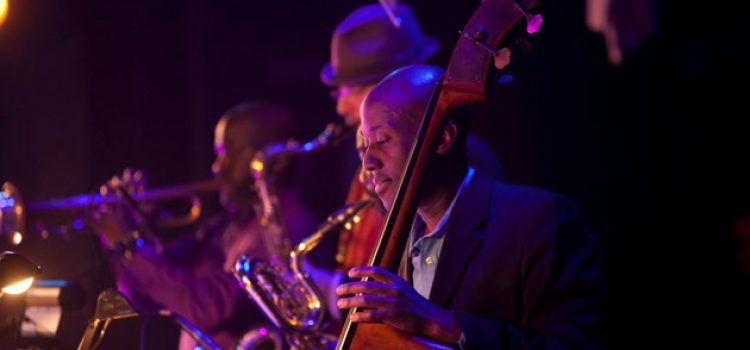
The Halsey Institute of Contemporary Art at the College of Charleston, in collaboration with the Charleston Music Hall, presents an evening of music featuring Charleston’s finest locally and nationally recognized musical acts on January 31, 2015 at 8 p.m. at the Charleston Music Hall (37 John St. Doors open at 7 p.m.).
READ THE FULL STORY [+]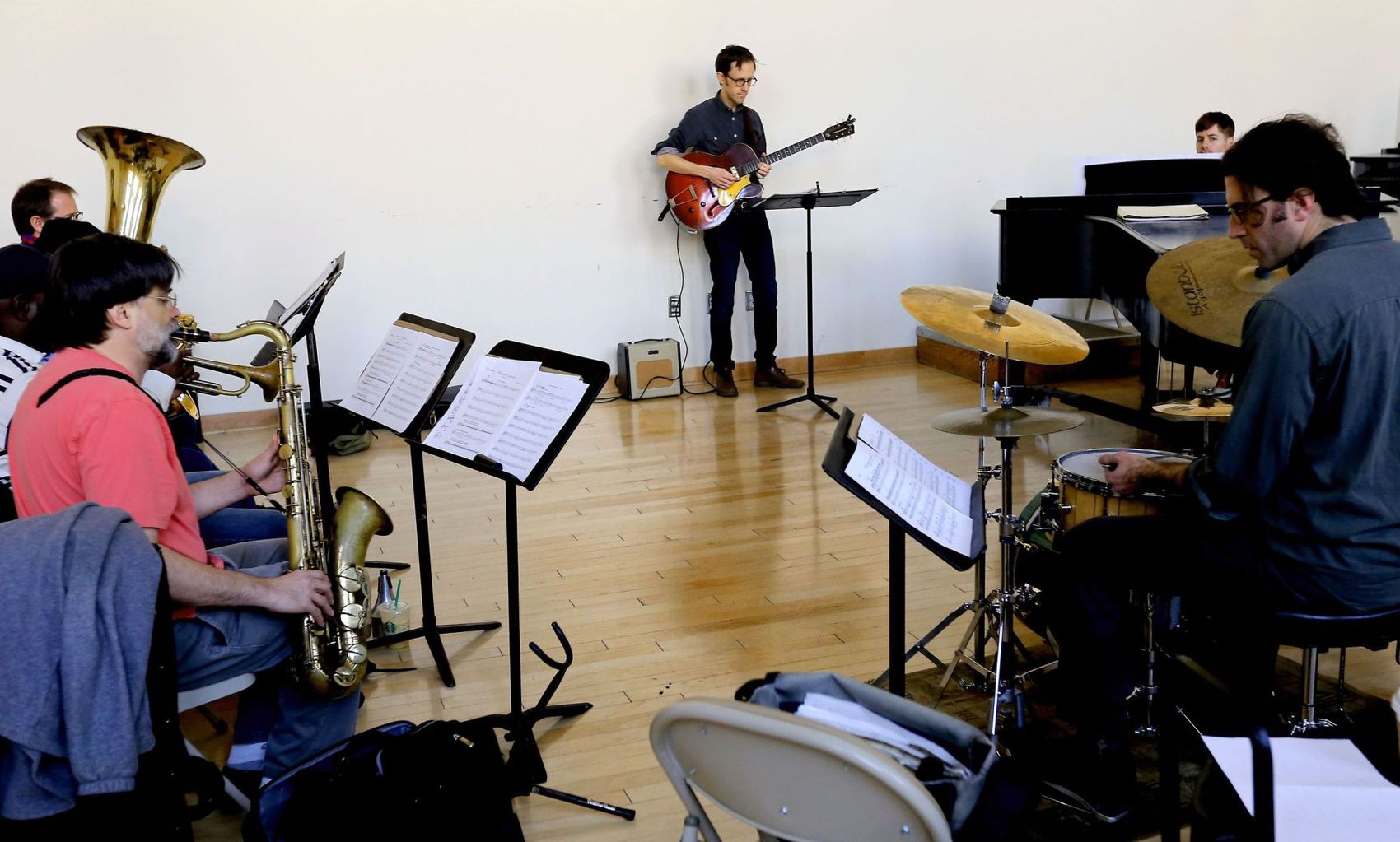
He’s probably not the first one you’ll notice on stage. His is a small white flame charisma, not a raging red burn.
Bill Carson is slight, bespectacled, quiet, perfectly content to show off his friends. He stands there, unassuming, behind his twangy hollow-body guitar.
So it might come as a surprise to discover that Carson is the primary force making all this music happen.
READ THE FULL STORY [+]
Offering technical experimentation, metaphoric expansiveness and curiosity, Patterns of Place does not look like any other art that has been made before, and includes a series of six three-dimensional maps that Potter calls Isomorphic Map Tables and 100 1:1 Map Insets, as well as an extensive catalogue and a video about the artist.
READ THE FULL STORY [+]
In a blog post today, street artist Shepard Fairey laid out his top five moments of 2014 and lo and behold: the show he did this May at the Halsey Institute for Contemporary Art was number one. The Insistent Image: Recurring Motifs in the Art of Shepard Fairey and Jasper Johns comprised not only Fairey’s prints and paintings, but also four murals and one installation in five different spots in Charleston. (Read our cover story, “Raw Power: Shepard Fairey explores empire and the American Dream this Spoleto season,” on the exhibit here.)
READ THE FULL STORY [+]
The Halsey Institute of Contemporary Art may be housed in a modest suite of gallery and office space on the College of Charleston campus, but its reach far exceeds its physical footprint. With a primary focus on artists “in the margins,” as Chief Curator Mark Sloan puts it, the museum shines a spotlight on artists who, given the depth, quality, and imaginative impact of their work deserve to be much better known. As we learned when we spoke with Sloan by telephone, the Halsey deploys a number of strategies to support the artists it shows. Artists receive not only time and space to work at the Halsey in an artist residency, but the considerable resources of the College of Charleston faculty and staff as well as the Charleston community-at-large are available to support the artist’s vision, whether that means technical expertise, help in the studio, participation in conversations with the artist and other events, or even a place for the artist to live while in town. In addition, the organization produces high-quality educational and outreach materials around the artists and their work, including short films, catalogues, and an expansive online presence on the Halsey website. The Halsey recently received an NEA grant to support an exhibit on the work of visual artist and musician Lonnie Holley. In his own words, here is Mark Sloan on the Halsey’s artist-focused curatorial philosophy, the museum’s plan for the Holley exhibit, and how the artists they feature are a little like snowflakes.
READ THE FULL STORY [+]
Looking at the Indonesian artist Jumaadi’s works, one is reminded of art from long, long ago: ancient Greece, perhaps, or the cave paintings of Lascaux.
It’s not because of any similarities in style. Jumaadi’s work, which will be on display at the Halsey Institute of Contemporary Art through Dec. 6, is rougher, without the formal constraints of the Greeks or the fluidity of Lascaux. Rather, it’s because Jumaadi’s visual language, like those bygone artists, is one of archetype. Rain, trees, wild beasts, and stark, disembodied human faces haunt his paintings and drawings, creating a world of primordial and universal symbols that one could devote much time, and anthropological study, to reading.
READ THE FULL STORY [+]
Beginning in October, the Halsey Institute of Contemporary Art will feature Indonesian artist, Jumaadi, and his exhibition Forgive Me Not To Miss You Not. Jumaadi has exhibited globally in Australia, Europe, Asia, the Netherlands, and he was recently selected for the Moscow Biennale. This is a hallmark exhibition—his first in the United States. As the Halsey’s International Artist in Residence for Fall 2014, for the past two months, Jumaadi has had the opportunity to foster a meaningful relationship with the Charleston community while developing his exhibit.
READ THE FULL STORY [+]
In 1981, John Baldessari said, “Probably one of the worst things to happen to photography is that cameras have viewfinders…” but artist Yaakov Israel would certainly disagree.[1] Israel’s photographs in The Quest for the Man on the White Donkey at the Halsey Institute for Contemporary Art in Charleston, South Carolina, are carefully constructed. Israeli-born and -based, Israel relishes the serendipitous encounters he’s had while exploring the geography and people of his native land, and this show is a case in point: As he was packing up his equipment after a long day in the desert looking for subjects for his photographs, Israel was approached by an elderly man riding a white donkey. He convinced the man to sit for a portrait, quickly assembled his equipment, and captured the image The Man on the White Donkey, HaBiqah (2006). Intrigued by this chance occurrence—it uncannily invokes the Orthodox Jewish tradition of the messiah arriving at the end of days on a white donkey—Israel then used it as the titular inspiration for this series, a body of work rife with chance findings and encounters in the Israeli landscape.
READ THE FULL STORY [+]