
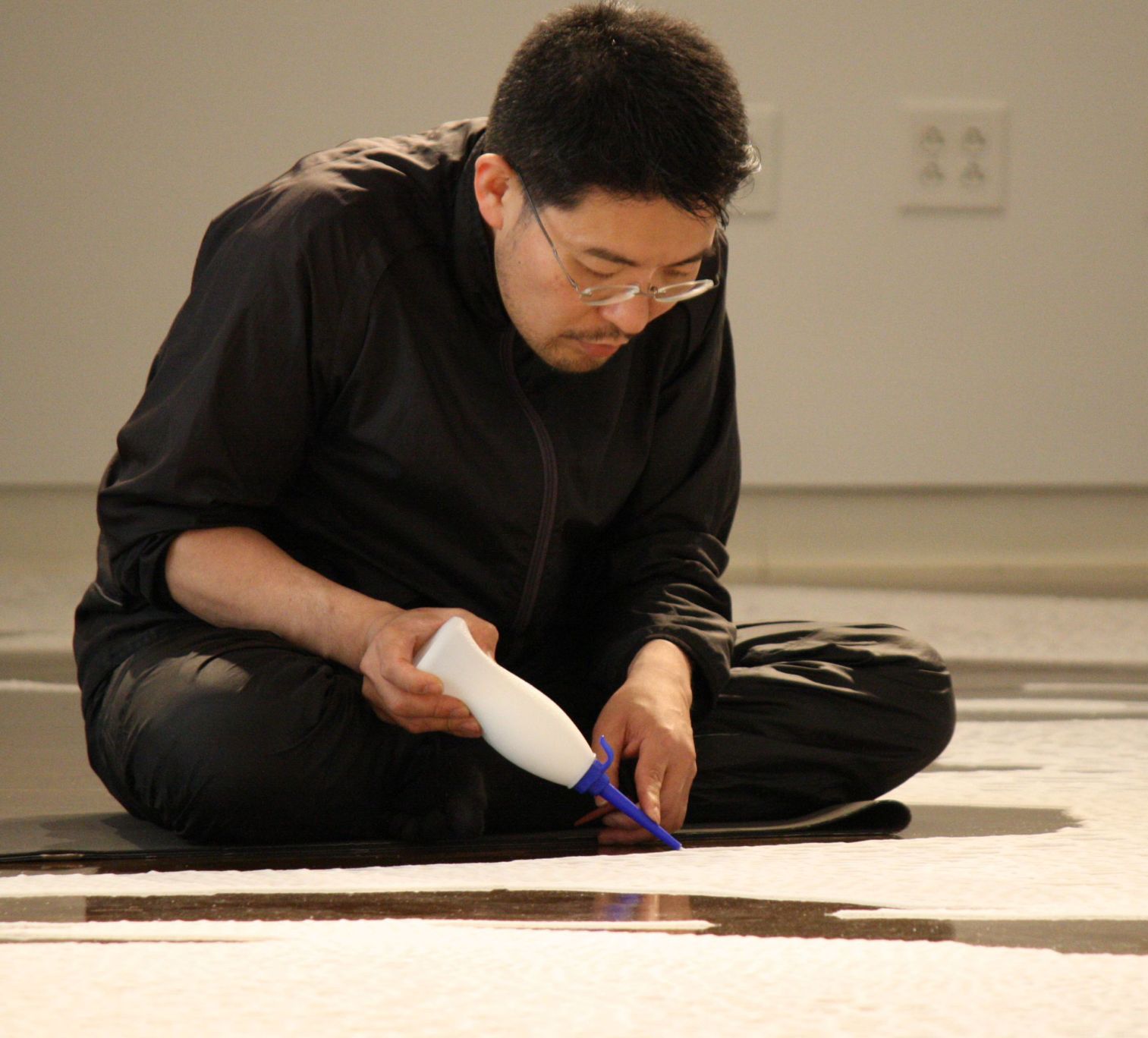
Motoi Yamamoto shifts his weight on the mat he is kneeling on, sitting up from his work and surveying the mammoth design on the floor of the gallery. The 46-year-old Japanese artist wears all black, wire-rimmed glasses and socks with five toes. He blows out a breath and hunches over his work, tilting a bicycle squeeze bottle to draw a curlicue pattern on the floor with a trickle of table salt, like a baker adding piping to the rim of a cake.
The work expands, inexorably, slowly, until its large design is discerned.
“Return to the Sea: Saltworks by Motoi Yamamoto” opens at the Halsey Institute of Art, the latest of Yamamoto’s full-scale installation pieces that have appeared across the world, and once before at the Halsey, in 2006.
READ THE FULL STORY [+]If a tree falls in the forest and no one is around to hear it, does it make a sound? That old question implies that one wouldn’t occur without the other, and grants the listener a role of importance in the process. Ephemeral art is defined as “lasting only a short time,” and like that proverbial tree, depends on the viewer to be seen. A well-known example of ephemeral art is the Tibetan sand mandalas. In Saltworks: Return to the Sea, Motoi Yamamoto doesn’t mind the impermanence of his work and says it’s the process that matters.
READ THE FULL STORY [+]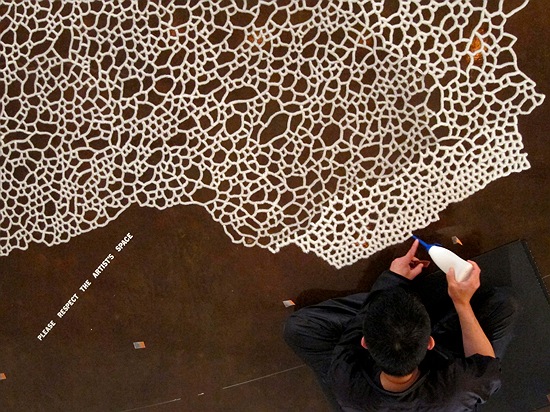
We stopped by the Halsey Institute this morning to see artist Motoi Yamamoto putting the finishing touches on his site-specific installation made entirely of salt. He’s spent the last two weeks using the main gallery floor as his canvas to create an intricate labyrinth. Guests are invited to walk around but not within the installation, and platforms have been built to allow for a bird’s eye view.
Return to the Sea: Saltworks opens on Thurs. May 24 from 5-7, but we encourage you to stop by now when you can see Yamamoto in action, squeezing salt from a small ketchup bottle. We hear the opening reception will be Japanese-themed, complete with sake, Japanese beers, and maybe even sushi.
READ THE FULL STORY [+]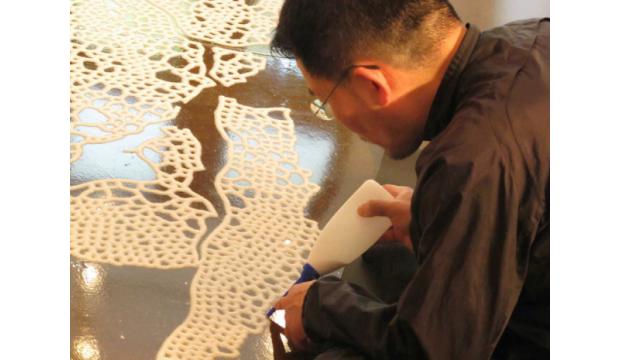
The visual arts offering is the Halsey Institute of Contemporary Art’s show by Motoi Yamamoto, who uses salt to create large-scale art installations that resemble — depending on how you view it — lace, waves or mazes.
The Charleston installation won’t be completed until the night before the festival opens, because Yamamoto works painstakingly sitting on the floor to create patterns for the installation. But Yamamoto sees his work as a form of meditation.
READ THE FULL STORY [+]Even the most dedicated student might struggle through a graduate-level Shakespeare seminar. But for poet Emily Rosko, it’s where she found the inspiration to write her latest book.
Now an assistant English professor at the College of Charleston, Rosko was working toward her PhD in literature and creative writing at the University of Missouri when she started writing Prop Rockery. Inspired by the language of the Bard and other early modern writers, she started a series of poems that play off of lines from those texts.
“I was being saturated in that kind of language that [Shakespeare] had, which of course is so wonderfully peculiar to our ears,” Rosko says. “And the energy of the poetry that emerged from his plays was something that sort of fueled my own writing at the time.”
READ THE FULL STORY [+]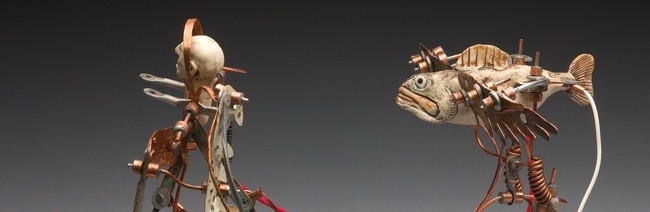
Imagine you’re reading a story filled with quiet women surrounded by animals, little men with human bodies and elephant heads, and copper-and-ceramic horses that look a little steampunk, a little classical.
That, in a sense, is what looking at the work of Virginia-based painter and sculptor Aggie Zed is like. She seems to have tapped into some element of art-making that allows her to spark her viewers’ imaginations, igniting their own creativity. Zed has concrete proof of this, although she would never go so far as to call it that: A collector of Zed’s ceramic figures once sent Zed a story she had written using the little figures as characters.
READ THE FULL STORY [+]
Aggie Zed, whose work is currently on display at the Halsey Institute of Contemporary Art in Charleston, grew up here on Sullivan’s Island. The show, comprised of sculpture, paintings, drawings, sketchbooks and installations, had never before been seen before the much-anticipated opening, held on Friday, January 20.
The opening was attended by a crush of 800 people. The lecture, held the following day, was equally crowded. Originally planned as a gallery walk-through, it was necessary for attendees to line walls and sit on the floor, in order to have their burning questions answered by Aggie Zed herself. Fittingly, the first inquiry of evening regarded Aggie’s childhood on Sullivan’s Island and how that unique experience has come to influence her work.
READ THE FULL STORY [+]
The Halsey Institute of Contemporary Art is $10,000 richer, thanks to the National Endowment for the Arts. The organization’s Challenge America Fast-Track program awards grants to small and mid-sized arts organizations around the country, particularly places that bring the arts to underserved audiences. The Halsey is one of 162 winners in 46 states.
The grant will support a two-week residency and exhibition by Japanese artist Motoi Yamamoto, who’ll be visiting as part of the 2012 Spoleto Festival in May. Yamamoto’s project, Return to the Sea: Saltworks, will be a large-scale installation made out of salt. There will also be works on paper and an artist documentary created by the Halsey. The artist will participate in workshops, demonstrations, and artist talks that will be open to the public.
READ THE FULL STORY [+]
Galileo created the first telescope in the 17th century, and now, 400 years later, we’ve got Google Moon, an application that allows users to get a live satellite view of the lunar surface. In 2009, scientists found water on the moon, and College of Charleston Professor Cassandra Runyon was one of the lead scientists in the discovery. The following spring, she received a NASA grant to mount a moon exhibition, and she asked Halsey director Mark Sloan to curate. The result is the Halsey’s large-scale exhibition, From the Moon: Mapping & Exploration, which offers viewers a comprehensive examination of our relationship with our “sister sphere.”
READ THE FULL STORY [+]
If Tanja Softic and Hamid Rahmanian have one thing in common other than their immigration to the United States, it’s their belief that everyone can relate to the experience of an immigrant.
Softic came to the U.S. from the former nation of Yugoslavia more than 20 years ago, while Rahmanian arrived from Iran in 1995. Today, they are both artists exploring that journey through their work. Their pieces come together at the Halsey Institute of Contemporary Art this week.
READ THE FULL STORY [+]