
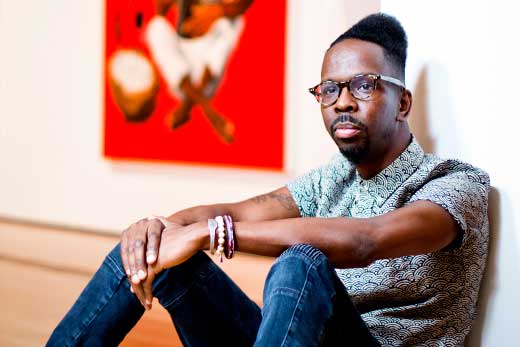
Not every PhD candidate has elements of their dissertation displayed in an art gallery, but Fahamu Pecou has never followed the typical path for a doctoral student.
Among the 275 students set to receive PhDs from Emory’s Laney Graduate School next week, Pecou has already been making headlines — a thinking person’s artist and an emerging force in the art world with works that explore challenging issues of black identity and cultural representation.
…
His work is already receiving critical acclaim. Presented at the Halsey Institute of Contemporary Art in Charleston, South Carolina, in collaboration with the Michael C. Carlos Museum at Emory, “Do or Die” is now touring the country and will be installed at the Carlos Museum in January 2019.
READ THE FULL STORY [+]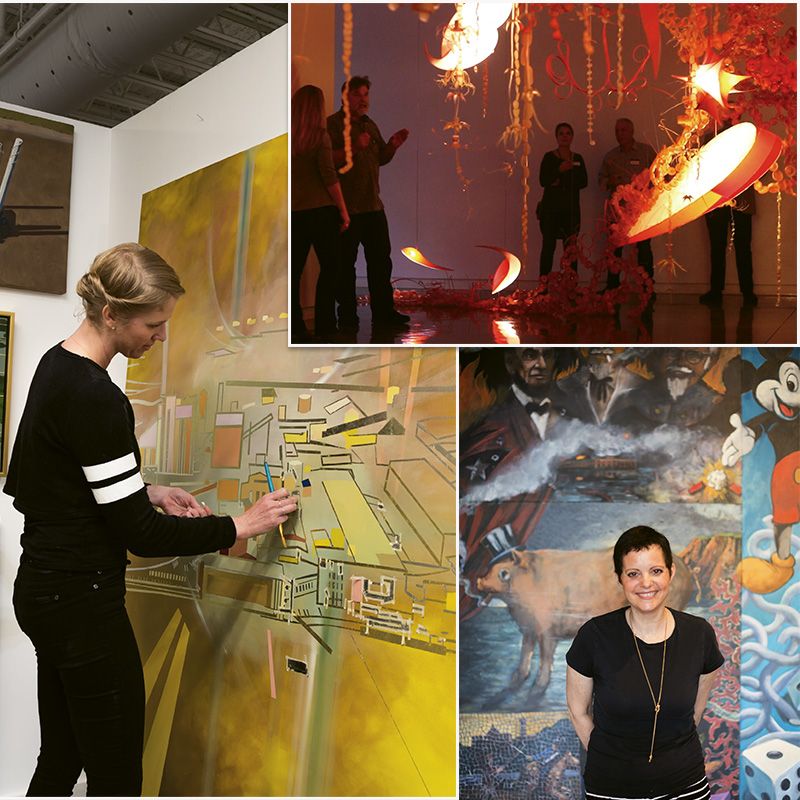
Charleston’s growth has been a boon for, and in part driven by, its creative community. The return of festival season is a good opportunity to take its pulse and peek backstage at the studios, galleries, and theaters of our evolving and maturing arts scene.
There was a moment when it all coalesced. May 27, 2016: opening night of Spoleto’s Porgy and Bess at the Charleston Gaillard Center. Exuberant costumes in candy-store colors designed by the Lowcountry’s own Jonathan Green; Gershwin’s score, written right here nearly a century ago, roused to melodic brilliance by an orchestra that included some local musicians: a story from our past brought to life in a dazzling new theater heralding a promising future. All headlining the 40th anniversary of a festival that put Charleston on the international cultural map.
…
The state of the arts in greater Charleston is thriving, affirms Scott Watson, head of the city’s Office of Cultural Affairs. “The arts imbue every corner of this community, coexisting alongside oyster roasts and wildlife expos. Our artists and arts organizations are highly visible, celebrated, and resilient,” says Watson. And every arts organization leader interviewed for this story echoes his assessment. They report that their audiences as a whole are healthy and growing. The range of exposure of various forms of art presented by artists both emerging and established is more diverse than ever, and becoming even more so. Yet when Mark Sloan moved to Charleston to take the helm of the Halsey Institute of Contemporary Art (then called the Halsey Gallery) nearly 24 years ago, he found a very different cultural landscape.
READ THE FULL STORY [+]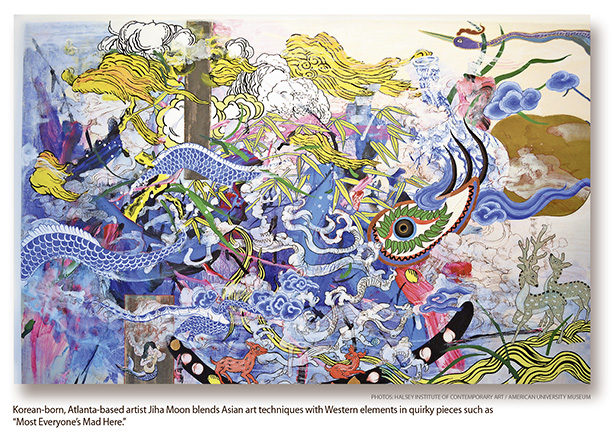
A kaleidoscope of colors, pop culture references and traditional Asian art techniques collide in “Jiha Moon: Double Welcome, Most Everyone’s Mad Here,” an exhibition suffused with both satirical whimsy and contemporary relevance.
The show, at the American University Museum, is a quirky surprise from an artist who revels in playing games and posing probing questions. Images of Angry Birds and emojis mix with Asian tigers and Indian gods in compositions that incorporate Eastern art techniques and iconography through the use of Hanji paper and Korean silk, peaches and fans. It’s a fun, irreverent show that blurs the lines between East and West, the familiar and the foreign, using small details to ask big questions about racial perceptions, technology and global identity.
“I think that Jiha Moon’s work has this really universal appeal to it. It’s colorful, there are a lot of references to popular culture, but the more you look at it, the more you realize she’s making very smart and sometimes satirical commentary about objects or imagery that have been associated with Asian culture [but] not necessarily part of Asian culture,” curator Amy Moorefield told The Washington Diplomat.
Take, for instance, Moon’s use of fortune cookies. The artist’s ceramic fortune cookies reflect the history and interplay of cultures that characterizes the core of her work. As Moorefield noted, “Fortune cookies have been sort of assigned to China or Asia, but they were developed in California. It’s really a smart way of her responding as an artist, who was born in Korea but lives in Atlanta, to say, ‘Hey, I’m not defined by one culture. I’m defined by many. And my work embraces all of that.’”
Look closely and visitors will see the all-too-familiar Facebook “F” logo, followed closely by a horseshoe — really, a “U” — a symbol of good luck. “I don’t want my work to appear whiny or too serious about it. I always love humor and jokes in art,” Moon said in a video about this show produced by the Halsey Institute of Contemporary Art.
READ THE FULL STORY [+]
East and West converge in different ways in the work of Miya Ando and Jiha Moon, two Asia-rooted female artists who have shows in adjacent galleries at the American University Museum. While Moon’s art includes some conspicuous American ingredients, Ando’s work might seem to be purely Asian.
Unlike Moon, Ando is a lifelong American citizen. She was born in Los Angeles to a Japanese mother and an American father of Russian Jewish heritage. Moon was born and educated in South Korea before earning an M.A. in Iowa, moving to Washington and then settling in Atlanta.
…
No muscle cars are evident in Jiha Moon’s “Double Welcome, Most Everyone’s Mad Here,” but there are many other American things. Smiley faces, video-game characters and Pennsylvania Dutch folk symbols jostle in the artist’s busy collage-paintings, alongside Asian-style birds, tigers, dragons and flowers. Peaches represent fecundity in Asia, as well as Moon’s now-home of Georgia. “I am a cartographer of cultures,” she writes in her artist’s statement.
The balance is tipped more toward East than West, in part because many of the pieces are painted on fan-shaped pieces of Korean-made mulberry paper. The dominant visual motifs are usually Asian, although acrylic paint is paired with ink, and shards of text employ the Latin alphabet as well as Korean and Chinese writing systems.
READ THE FULL STORY [+]
Earlier this year I met with Halsey Institute of Contemporary Art director Mark Sloan and manager of outreach and engagement Lizz Biswell. The two excitedly shared the Halsey’s upcoming exhibits — from the passion of emerging artists in Young Contemporaries to the raw realities of the Southern United States in Southbound, each exhibit piques the interest of art lovers of all stripes.
But the exhibit Sloan and Biswell were most excited about is one that opens this May in conjunction with Piccolo Spoleto, The Carrion Cheer: A Faunistic Tragedy, the first United States solo exhibition from artists Matthias Böhler and Christian Orendt, curated by the Halsey’s manager of exhibitions and programs, Bryan Granger.
The reason for Sloan and Biswell’s excitement? Well, it’s likely got a lot to do with the uncertain nature of the exhibit — neither the Halsey nor the artists, Böhler and Orendt, know exactly what will happen. Here’s the deal: Böhler and Orendt (who are currently in town building components of the exhibit) are constructing a “makeshift trans-dimensional stopover camp,” featuring several tents that guests can walk through.
READ THE FULL STORY [+]
The idea, Roefs added, is to extend the amount of time people spend in Lake City for art. By having more exhibitions and public art, it’s hoped that more people will make a two- or three-hour drive from larger areas and maybe even spend a night or two in the town to check out all of the art and activities connected with it. In other words, the idea is to make Lake City into a year-round arts destination.
“TRAX is instantly one of the best art centers in South Carolina in terms of linear wall space and square footage,” Roefs said. “The three big ones in the state are the Halsey Institute at the College of Charleston, 701 Center for Contemporary Arts in Columbia, and, now, the TRAX Visual Arts Center in Lake City.”
As the center just opened, assessing the effect will take time. However, Roefs added that he’s heard and seen the crowds at ArtFields are bigger this year than they have been.
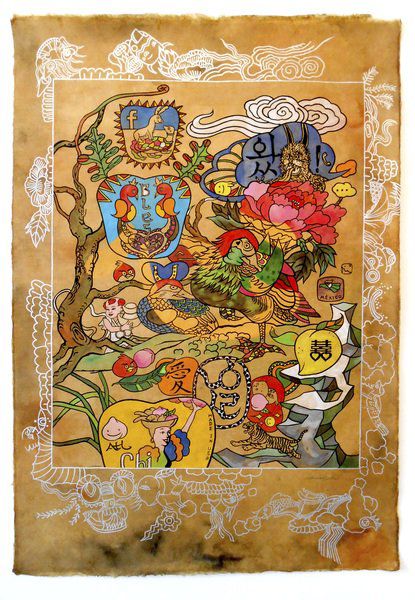
Jiha Moon: Double Welcome, Most Everyone’s Mad Here features new work by multimedia artist Jiha Moon. Moon harvests cultural elements native to Korea, Japan, and China and then unites them with Western elements to investigate the multifaceted nature of current global identity as influenced by popular culture, technology, racial perceptions, and folklore. Featuring more than 50 works, Moon blurs the lines between Western and Eastern identified iconography with use of characters from the online game Angry Birds© and smart phone Emojis, which float alongside Asian tigers and Indian gods in compositions that appear both familiar and foreign simultaneously. Moon’s witty and ironic work explores how Westerners perceive other cultures and how perceived foreigners see the West. Honoring traditional Asian arts through her use of Hanji paper, Korean silk, and calligraphic brushstrokes, she plays with iconography and symbols that have been classified as “foreign,” such as blue willow china patterns, fortune cookies (which originated in California but are identified as Chinese), Korean fans, and floating dragons and intermingles them with references to Pop and southern folk art. This exhibition is presented as part of the Visiting Artist Program organized by AU Studio Art. Jiha Moon: Double Welcome, Most Everyone’s Mad Here is organized by the Taubman Museum of Art, Roanoke, Virginia in collaboration with the Halsey Institute of Contemporary Art, College of Charleston School of the Arts in Charleston, South Carolina. The exhibition is curated by Amy G. Moorefield, former Deputy Director of Exhibitions and Collections at the Taubman Museum of Art and Mark Sloan, Director and Chief Curator of the Halsey Institute of Contemporary Art. Gallery Talk: Friday, April 13 at noon.
READ THE FULL STORY [+]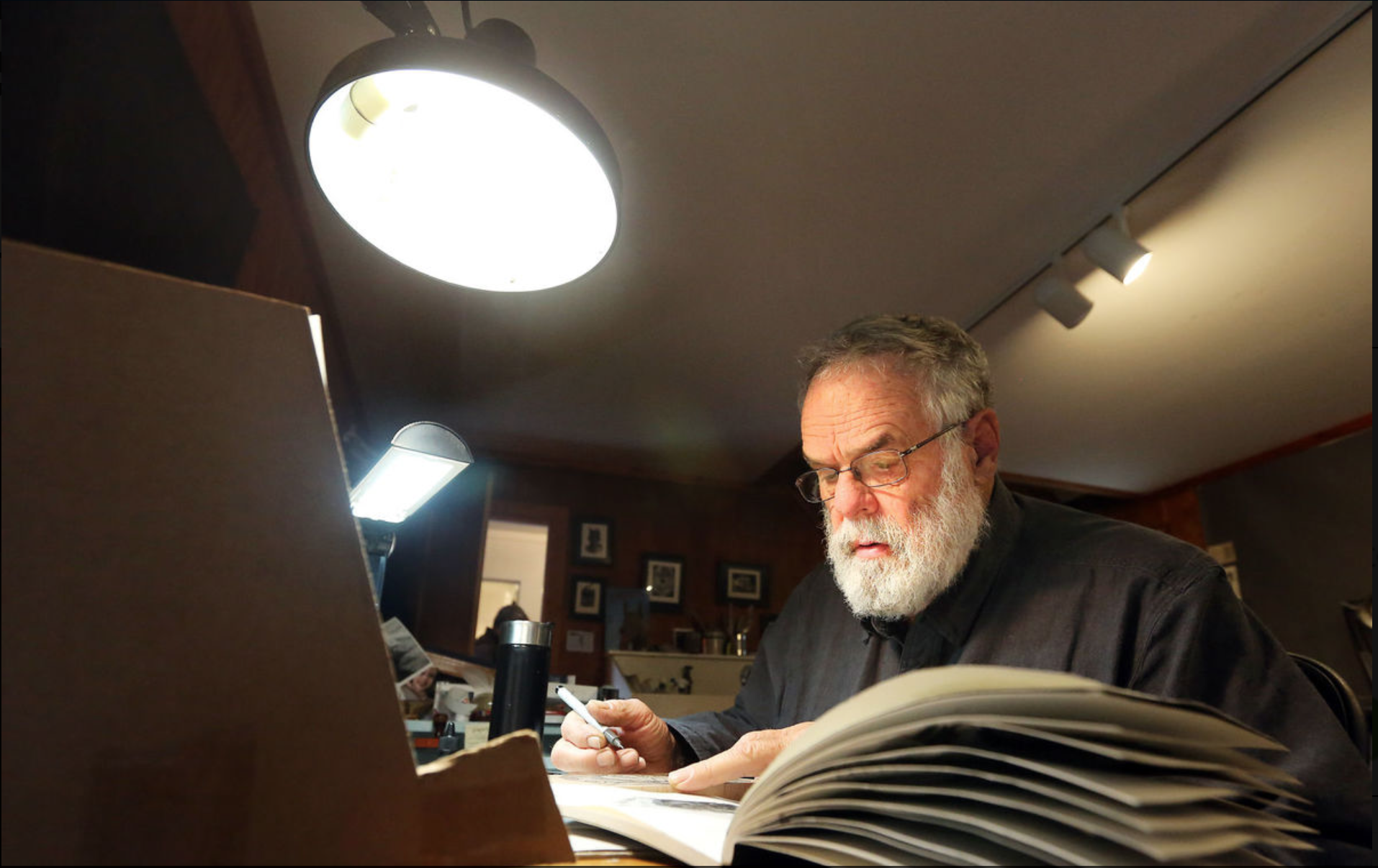
The Halsey Institute of Contemporary Art collaborated with Horse & Buggy Press to produce a special limited edition of “Sons & Father,” a small-format volume featuring McWilliams’ woodcut prints.
The book was an ancillary product of a 2016 exhibit at the Halsey called “Prophesies,” an important showcase of the work of the famously modest artist.
“I first learned of John McWilliams back in 1989 when his book ‘Land of Deepest Shade’ came out,” Sloan said. “I heard him give an artist talk at a national conference in the early 1990s, at which he showed images and told the story of building his own boat and sailing it to Bermuda. The story was riveting, and the images incredibly moving.”
Sloan marveled as McWilliams developed his printing style.
“I see him very much in the tradition of William Blake,” he said. “His works are singularly dark and foreboding. They are allegorical in their meaning. Another strong component in his work is the narrative arc. In this way, he is something of an acolyte of Lynd Ward, the graphic novelist of the 1930s. I see that both his photography and printmaking share a certain affinity for the transformative power of nature. Nature is often pitted against human nature in John’s compositions. Are we are part of, or apart from nature, he seems to be asking.”
READ THE FULL STORY [+]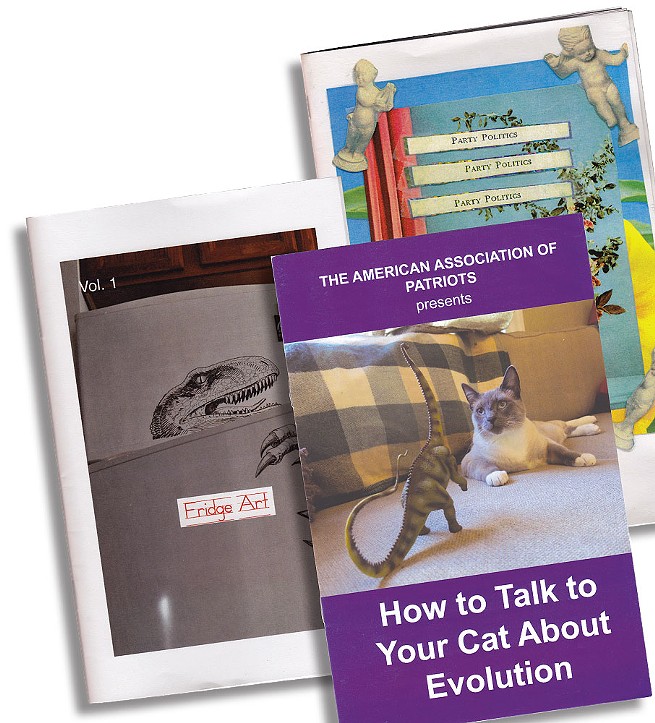
The Charleston Zine Fest returns on July 28 for its third annual installment. This year, the magazine celebration is being held at the College of Charleston’s Halsey Institute of Contemporary Art. As always, it’s free to the public.
Every year, the Charleston Zine Fest honors all forms of zines, from comics to poetry to how-tos. In the past, CZF has hosted regional comic companies, like Monk Comics and Monstieur Comics of Greenville, as well as unique zines like “How to Talk to Your Cat About Evolution” and “Give a Five-Minute Blowjob in Three Easy Steps.” Last year’s event also included a panel discussion on the continuing importance of print media.
This year’s vendors and events have not been announced yet, but check back in on their Facebook page soon for an updated list. If you want to be a vendor or have a zine of your own that you want to promote, there’s still time to sign up. Just fill out their quick form.
The team behind the Zine Fest is also looking for ideas to make the festival as inclusive, educational, and impactful as possible, so if you have any suggestions for activities, you can send them to charlestonzinefest@gmail.com.
READ THE FULL STORY [+]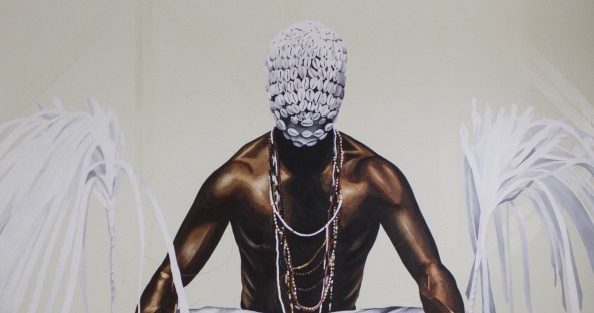
In 2002, a message appeared: “Fahamu Pecou Is the Shit!” The bold declaration, which appeared on stickers and posters around New York City, told it like it was, announcing the arrival of a new artist coming straight out of Brooklyn. Pecou, who had been doing graphic design for hip hop stars, decided to bring the language of the streets to fine art.
Over the past two decades, Pecou has used his work explore, examine, and embrace the power and presence of black masculinity in a country that alternately marginalises, fetishises, and vilifies countless lives.
With the publication of Visible Man (Halsey Institute of Contemporary Art, College of Charleston), a simultaneous two-year exhibition tour across the United States, and a concurrent exhibition MEMORY at Lyons Wier Gallery, New York (closing 31 March), Pecou looks at the ways in which the media and pop culture shape the relationship between representation and identity.
READ THE FULL STORY [+]